
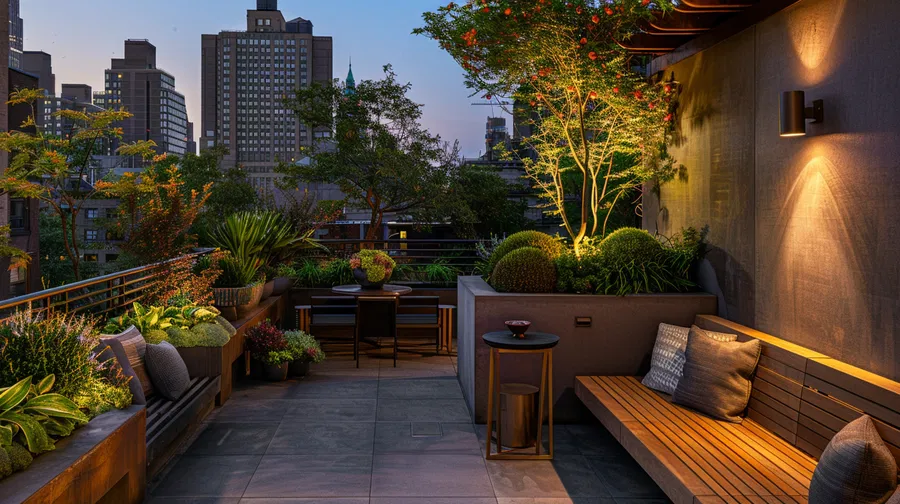

A minimalist terrace should feel open, easy, and quietly elegant. It’s the place where fresh air meets simple forms — a space that asks less of your eyes and gives more back to your mind. Fewer pieces, clearer lines, and materials that weather gracefully let you relax without managing your surroundings.
Think in functions, not objects. One table that flexes from coffee to dinner. Seating that moves in a single gesture. Lighting that guides without glare. When each element earns its place, the terrace becomes effortless—morning to night.
The Essence of a Minimalist Terrace#
Start with space, not stuff. Clear the floor, simplify the edges, and keep the viewlines clean. Your boundaries — railing, wall, planters — should read as quiet frames, not a crowd of details.
Choose a short list of materials and repeat them. Warm wood, pale stone, and a soft black or charcoal metal create calm contrast without visual noise. Let texture do the talking: slatted timber, honed pavers, woven fiber.
Commit to low profile. Seat heights stay consistent; table legs tuck visually; planters gather in a few strong groups instead of scattering small pots. Negative space isn’t empty — it’s the design breathing.
Design for easy care. UV-stable finishes, quick-dry cushions, and hardware that resists corrosion keep the look consistent week after week. The less you fuss, the more you’ll use the terrace.
Layout and Flow#
Think of the terrace as one fluid room without walls. Keep the center open and push mass to the edges. Circulation should be obvious at a glance: door → seating → table → view, with no ankle traps or chair legs sticking into the path.
Choose an anchor axis. Align the main seating and table to the strongest line (railing, facade, or paver seam). When furniture obeys one geometry, the space feels larger and calmer.
Zoning without clutter#
Create zones with placement and proportion, not piles of objects. A low bench plus a single rug defines lounging; a compact pedestal table sets a dining node. Use one tall planter cluster to imply a boundary instead of three small pots scattered around.
Keep heights coherent. If seats are low, pick a low-profile table; if you need a standard dining height, keep adjacent lounge elements slightly apart so the mismatch doesn’t feel messy.
Sightlines, circulation, and edges#
Protect the long view. Keep anything above backrest height out of the sightline to the horizon; tall pieces live at the sides, never in the middle. Leave a clear walking lane of 60–90 cm (24–36 in) from door to seating so trays and bare feet move without sidesteps.
Treat edges like frames. Run furniture parallel to the railing or wall, and keep a slim perimeter gap (5–10 cm / 2–4 in) so nothing looks crammed. Group planters at corners or in a single offset cluster to “weight” the plan without blocking flow.
Palettes and Materials#
Minimalist terrace decor works best with a short, repeatable palette. Think warm wood, pale or mid-tone stone, and a soft black/charcoal metal. With three tones doing most of the work, the eye rests and the space reads larger.
Warm neutrals: wood, stone, soft blacks#
Start with one wood for warmth (teak, thermowood ash, or a stable composite with subtle grain). Pair it with light stone—honed limestone/porcelain that doesn’t glare in noon sun—and finish with matte black or charcoal metal for quiet contrast. If your facade is cool, slide the stone to beige/greige; if it’s warm brick, go slightly cooler on the stone to balance.
Repeat materials across pieces: the bench slats match the planter top rail; the table legs echo the railing color. One accent only—olive cushions or a clay planter cluster—is enough. Let texture carry variety: slats, honed surfaces, woven fiber.
Finishes that weather well#
Outdoors, finish choice is the difference between calm and constant upkeep.
Wood
- Teak / iroko: ages to silver; oil if you want to hold honey tone, otherwise leave bare for low maintenance.
- Thermowood: dimensionally stable, takes stain evenly.
- Composite decking: low care; pick a fine-brush texture to avoid “plastic shine” and improve wet grip.
Stone & tile
- Porcelain pavers (20 mm) with honed/matte finish: UV-proof, stain-resistant, and easy to wash; pick a slip rating suitable for wet feet.
- Cast concrete / microcement (exterior-rated): beautiful in large fields; seal against stains and re-seal per manufacturer cadence.
Metals
- Powder-coated aluminum: light, rust-free, excellent for frames.
- E-coated, then powder-coated steel: good if you need weight; avoid chips.
- Stainless: 316 near sea air; 304 inland.
Textiles
- Solution-dyed acrylic or olefin: colorfast and quick-dry. Pair with reticulated (quick-dry) foam so cushions don’t sponge water. Choose zipper covers you can hose off.
Hardware
- UV-stable glides, marine-grade screws, and hidden leveling feet keep lines crisp and prevent wobble on pavers.
Maintenance rhythm (simple and repeatable)
- Rinse dust weekly in dry seasons.
- Wipe table/bench after use; no glossy polishes—matte keeps the look minimal.
- Re-seal stone/microcement on schedule; spot-oil wood only if you maintain the warm tone.
Furniture with a Low Profile#
Low, coherent silhouettes make a terrace feel bigger. Keep seat backs below the sightline and choose frames that “disappear” (slim powder-coat, tight shadow gaps). Fewer pieces, each doing more, beats a scatter of chairs.
Slim seating and modular benches#
Go for low-profile lounge chairs and bench modules you can rearrange. Target seat height around 38–43 cm (15–17 in) so cushions don’t block the view. Backrests should sit just under average rail height; if your railing is 100–110 cm (39–43 in), keep backs well below that.
Benches work hard against edges. Depth around 45–55 cm (18–22 in) fits most bodies without hogging floor area; add quick-dry cushions 5–8 cm (2–3 in) thick with reticulated foam. Use corner blocks or a single L-bench to “complete” a lounge zone with one move. Add hidden leveling feet so lines stay crisp on uneven pavers.
Prefer open bases (legged) over chunky plinths—the shadow underneath lightens the composition. If you need lounge depth, use one chaise module rather than two bulky loungers.
One table that does it all#
A single low, stable table anchors morning coffee, laptops, and evening snacks. Size sweet spot: 60–80 cm (24–31.5 in) wide and 100–120 cm (39–47 in) long for a 2–4 person setup. Height 35–42 cm (14–16.5 in) suits lounge seating.
If dining occasionally, choose a lift-top or nesting pair: the main table stays low; a slim side pedestal (Ø 40–50 cm / 16–20 in) slides in for plates and glasses. Another option: a compact bar-ledge (depth 25–35 cm / 10–14 in) along the railing with two stools—dining without a full dining footprint.
Materials should match the palette you set: timber slats or honed porcelain for the top; slim matte frames; rounded corners (small radius) so the look stays soft and the knees stay safe.
Lighting for Evenings Outdoors#
Night lighting should feel like dusk—soft, legible, and never shiny. Start with a gentle base, then add small, precise accents only where hands and feet go. Keep fixtures low, shielded, and warm so the terrace stays calm and neighbor-friendly.
Ambient wash vs. task glow#
Use ambient wash to set mood: wall-grazing sconces, under-bench LEDs, or a soft up-bounce off a parapet. Aim for 2700–3000K (warm white) so wood and stone read natural. Skip bright downlights; indirect light makes surfaces glow without glare.
Add task glow only where needed: a small table lamp (outdoor-rated) for snacks/cards, or a slim sconce by the door handle. Target ~100–200 lm at task points and CRI ≥80 so food and faces look right. Keep lenses frosted or use skirts/shields; the eye should see lit surfaces, not light sources.
Keep controls simple: a single dimmer/timer for ambient, a separate switch for task. Low-voltage (12–24V) runs stay safe and discreet; group drivers in one weather-sheltered spot.
Low-glare paths and steps#
Mark movement, not the whole floor. For paths, place low bollards or recessed marker dots every 1.5–2.0 m (5–6.5 ft), staggered to avoid runway vibes. Shield emitters below eye level and cap output around ≤ 100–150 lm per fixture—just enough to read edges.
On steps, light the tread, not eyes: a 1–2 W stair light per riser or a continuous under-nose LED creates a soft bar of safety. Keep brightness even; avoid hot spots that crush night vision. Maintain a clear walking lane of 60–90 cm (24–36 in) and let the light “touch” that band.
Hardware sanity:
- Outdoor/IP rating that matches exposure (IP65+ for direct rain, IP44+ for covered).
- Warm color (2700K) for lounge, 3000K max near doors.
- Glare control: louvers, hoods, frosted diffusers.
- Automation: dusk-to-dawn sensor + 3–5 h timer; motion only for path, not for ambient.
Quick placements
- Indirect wall wash or under-bench strip for base mood
- One shielded sconce at the door pull/lock
- Low bollards or recessed dots along the walking band
- Under-nose step light per riser (no visible diode points)
Plants, Planters, and Scale#
Greenery adds softness and privacy without breaking the minimalist line. Think in outlines and masses, not a scatter of pots. Keep foliage shapes simple, repeat species, and let planters act like low architecture that frames the space.
Fewer, larger planters#
Go big and reduce count. One cluster of 3 planters beats 7 small ones every time. Aim for diameters 40–60 cm (16–24 in) and heights 45–70 cm (18–28 in) so foliage reads as a calm mass, not visual noise.
Keep forms clean—cylinders, cubes, or tapered rounds. Match finishes (matte fiber-cement, powder-coated aluminum) and stick to one color across all planters.
Weight and wind: pick wide bases or add ballast so pieces don’t tip. Use lightweight soil mixes with perlite/pumice; raise roots on pot feet for drainage. Hide irrigation with a slim drip line and a mulch top (fine gravel or coco chips) for an orderly surface.
Placement rule: anchor corners and seams (by railing posts, facade joints). Leave 30–45 cm (12–18 in) between planter edges and seating so flow stays clean and cushions don’t brush leaves.
Evergreen structure, seasonal accent#
Build a year-round backbone with evergreen forms:
- Upright (olive, bay laurel, bamboo in liners) for privacy ribs.
- Mounded (dwarf pittosporum, boxwood, rosemary ‘Arp’) for quiet volume.
- Trailing (ivy, dichondra) to soften hard edges.
Then add one seasonal layer you can swap: grasses (pennisetum, carex), herbs (thyme, mint in a single trough), or a restrained color note (white gaura, dusty miller). Keep the accent to one planter group so the palette stays minimal.
Care that fits routine: shared sun/water needs within each cluster; a weekly deep soak rather than daily splashes; slow-release fertilizer in spring; quick trim lines instead of heavy reshapes. If your terrace is windy, favor narrow leaves and flexible stems over big sails.
Quick picks
- Privacy: clumping bamboo (screened root box), podocarpus, Italian cypress (slim).
- Heat/low care: olive, rosemary, lavender, feather reed grass.
- Shade: aspidistra, fatsia, cast-iron fern + trailing ivy.
- Containers: fiber-cement matte grey, charcoal powder-coat, or warm terracotta (sealed).
Privacy, Shade, and Wind#
Control edges first: filter views, soften sun, and break the breeze without building a bunker. Keep lines slim and repeat the terrace palette so the add-ons feel designed, not improvised.
Screens and slatted dividers#
Use slatted screens (vertical or 45°) to blur sightlines while letting air pass. Slat width 20–40 mm (¾–1½ in) with equal gaps keeps privacy without heavy shade. Align slats to your strongest axis (railing or facade seam) so the new layer “belongs.”
Height matters. Aim 150–180 cm (59–71 in) to block seated views; go taller only where codes allow and wind loads are handled. Keep a 5–10 cm (2–4 in) gap at the deck for drainage and to lighten the base.
Materials: powder-coated aluminum for zero rust; thermowood/teak if you want warmth (expect silvering); fiber-cement panels for ultra-minimal planes. Anchor to structure, not just pavers—use hidden plates or post shoes; add adjustable feet to level on uneven surfaces.
For neighbors below, consider a solid lower 30–40 cm (12–16 in) and slats above—light stays, privacy improves, and cushions don’t brush through.
Umbrellas, sails, and compact pergolas#
Pick shade for your wind and footprint.
Umbrellas (center or offset)
Quick, flexible, great for renters. Choose a cantilever if you need clear floor under the canopy. Canopy size 2.7–3.3 m (9–11 ft) covers a lounge set; go 2700–3000K accessory lights if you add evening glow.
Base mass is non-negotiable: 60–90 kg (130–200 lb) for large cantilevers; add paver pockets or bolt plates where allowed. Close in gusts.Shade sails
Clean lines and strong geometry. Use triangles or hypars to avoid sag and ponding. Fabric should be HDPE, UV-stabilized with stainless fittings. Fix points must be structural (wall studs, steel posts), angled so water sheds. Maintain 20–30° tilt and 10–15% tension stretch; re-tension mid-season.Compact pergolas
Best for high-exposure terraces. Go aluminum with louvered roof if budget allows—blades close for rain and open for sky. For a lighter look, use timber/aluminum slats at 60–90 mm (2⅜–3½ in) spacing over a one-bay frame (roughly 240–300 cm / 8–10 ft span). Add side screens only on the windward edge to prevent a boxy feel.
Wind sense. If caps fly often, you’re in a channel. Keep solid panels perforated ≥30% or slatted; avoid big continuous canopies unless they’re engineered. In real gust zones, a wind break at 60–90 cm (24–36 in) height (planter + low screen) slows drafts right where people sit.
Quick specs
- Slats 20–40 mm (¾–1½ in), equal gaps; screen height 150–180 cm (59–71 in)
- Umbrella base 60–90 kg (130–200 lb); close in gusts
- Sail tilt 20–30°, fix to structure, HDPE UV fabric
- Pergola span 240–300 cm (8–10 ft); consider louvered roof for rain
Flooring and Surface Rhythm#
Your floor is the biggest visual field outdoors. Keep it quiet, drain it well, and use the layout to guide movement. One material (two at most) is plenty. Let rhythm come from plank direction, paver seams, or a slim border—not from color changes.
Decking vs. pavers vs. microcement#
Decking (wood or composite)
Feels warm and forgiving underfoot; visually lengthens the terrace if you run boards along the long axis.
- Boards: thickness 20–25 mm (¾–1 in); gap 4–6 mm (³⁄₁₆–¼ in) for drainage.
- Structure: joists 400 mm (16 in) on center (typ.), with shims/adjustable pedestals for level. Leave a 10–12 mm (⅜–½ in) perimeter gap against walls.
- Species/finish: teak/iroko silver gracefully; thermowood is stable; quality composite avoids “plastic shine.” Choose matte finishes; spot-oil wood only if you maintain the warm tone.
- Slip & heat: pick fine-brush or grooved profiles; in strong sun, mid-light colors stay cooler than deep charcoals.
Large-format porcelain pavers
Low maintenance and crisp; ideal for minimal lines.
- Size/thickness: 600×600 / 600×1200 mm (24×24 / 24×48 in) at 20 mm (¾ in) thick.
- Support: adjustable pedestals create a fast-draining plane; keep a slope of 1–2% away from the facade (≈ 10–20 mm per meter / ⅛–¼ in per foot).
- Joints: 3–5 mm (⅛–³⁄₁₆ in) spacers; align in simple stack or half-offset—avoid busy patterns.
- Spec: matte/honed surface with outdoor slip rating (R11 / high DCOF). Lighter stone tones reduce glare and heat soak.
Exterior microcement / cast-in-place overlay
Seamless, ultra-minimal look with a single tone from wall to edge.
- Build: exterior-rated system over a sound substrate; overall thickness 2–3 mm (¹⁄₁₆–⅛ in), then seal.
- Drainage: substrate must already hold 1–2% fall; microcement follows the base.
- Movement: add discreet control joints at 3–4 m (10–13 ft) intervals and at transitions; respect existing slab joints.
- Care: re-seal per manufacturer; choose a silky-matte topcoat to hide dust and footprints.
Layout rhythm (make it read calm)
- Run decking with the long dimension; stop lines at door get a slim picture-frame border 70–90 mm (3–3½ in) to finish edges.
- On pavers, align seams with the facade or railing; a single “band” (one course rotated or narrower) near the threshold anchors the plan without adding clutter.
- Keep cuts to the far edge; let full tiles/boards meet the primary view.
Practical notes
- Slope: 1–2% fall away from doors; add a small grate where water collects.
- Heights: mind thresholds—finished floor should stay 20–25 mm (¾–1 in) below the door sill to avoid splash-back.
- Feet & furniture: add UV-stable glides and adjustable levelers so lines stay true on pavers.
- Color: mid-light neutrals are the sweet spot—less glare than white, cooler than near-black.
Storage You Don’t See#
Clutter breaks the minimalist read, so hide it in the architecture. Build storage into benches, rails, and slim wall runs so surfaces stay clear and the terrace looks ready without staging.
Hidden benches and slim cabinets#
Bench storage. Use a fixed bench along a wall or railing with a lift-up seat on soft-close hinges/gas struts. Internal clear height 28–35 cm (11–14 in) fits cushions and throws; depth 40–50 cm (16–20 in) keeps the seat comfortable. Line the base with drain slots or a perforated plinth so moisture can escape, and add a rubber lip or drip edge to the seat to shed rain.
Slim cabinets. A shallow exterior cabinet (depth 20–30 cm / 8–12 in, height 90–120 cm / 35–47 in) swallows citronella, cleaners, and tableware without protruding into the path. Choose powder-coated aluminum or marine plywood + exterior paint; elevate on 10–20 mm (⅜–¾ in) feet to keep water off the base. Vent with hidden louver cuts on the sides so items dry between uses.
Trash/recycling, invisibly. Dedicate one bench bay to pull-out bins on stainless runners. Keep them within 60–80 cm (24–31.5 in) of the door for quick swaps. Add a silicone gasket strip behind the face panel to limit odors without big handles.
Grill and tools. If you cook outside, a rail-hung tool strip behind the grill keeps the counter empty. For tanks or bigger gear, a cabinet bay with a louvered door and non-sparking mat is safer than leaving it exposed.
Weather sanity.
- Seal horizontal joints; leave verticals vented.
- Use 316 stainless near sea air, 304 inland.
- Add UV-stable glides under anything that sits on pavers; levelers keep lines crisp.
- Label inside, not outside—clean look, faster resets.
Quick checklist
- Bench internal height 28–35 cm (11–14 in); depth 40–50 cm (16–20 in)
- Cabinet depth 20–30 cm (8–12 in); raised feet 10–20 mm (⅜–¾ in)
- Drain slots + side vents to dry gear
- Gas struts / soft-close to avoid slams at night
- One hidden bay for bins near the door
Textiles and Weather Care#
Textiles warm the terrace and soften sound, but they must earn their keep outdoors. Choose solution-dyed acrylic or olefin for covers (colorfast, UV-stable) and reticulated quick-dry foam inside so rain drains fast. Keep colors in your palette—warm neutrals with one quiet accent—and prefer matte weaves that don’t glare at noon.
Rugs, cushions, and quick-dry routines#
Rugs. Pick flatweave or low pile so chairs slide and crumbs sweep. Size to leave a border of 10–15 cm (4–6 in) around the zone; on tiny terraces, even 80×150 cm (31.5×59 in) anchors a lounge without crowding. Use a perforated/felted outdoor pad trimmed 2–3 cm (¾–1¼ in) smaller than the rug—water passes, corners stay flat.
Cushions. Keep seat pads 5–8 cm (2–3 in) thick with mesh bottoms and hidden zips for hosing off. Add tie-downs or anchor straps at the rear edge; in gusty spots, a slim under-seat strap to the frame beats chasing pillows. Store one spare cover per size—swap, wash, done.
Care loop (5–10 minutes).
- After use: shake cushions, stand them on edge for 30–60 minutes so foam sheds water.
- Weekly: hose rug and tabletops; a drop of mild soap, soft brush, rinse.
- After heavy rain: unzip covers, squeeze—not twist—foam; air in shade.
- Seasonal: deep clean, fully dry, then store textiles in a breathable bin (not airtight) to avoid mildew.
Mildew & sun sense. Shade beats bleach. Dry thoroughly, avoid trapping moisture under tarps, and rotate the sun-facing cushion to share UV load. If you must cover, use vented covers with tie points, leaving 2–3 cm (¾–1¼ in) air gap to breathe.
Wind sanity. Add discreet corner tabs on rugs to accept low-profile snaps or weights near edges; for cushions, choose covers with a subtle pebble texture—they grip better than slick weaves.
Quick checklist
- Solution-dyed covers + quick-dry foam
- Flatweave rug + vented pad, trimmed small
- Rear tie-downs / frame straps for cushions
- Hose + mild soap; dry in shade
- Breathable storage, not airtight
Small Terraces, Big Calm#
Tiny footprints get calm when pieces vanish or hug the edge. Keep the center clear, run storage along one side, and make every object fold, slide, or stack. One gesture should take you from coffee to laptop to two plates at dusk.
Foldables, wall-mounts, and niches#
Foldables that disappear. A slim bistro set that folds flat (seat height 45–47 cm / 18–19 in) hangs on wall hooks or slides behind a bench. Choose tables that close to ≤ 8–10 cm (3–4 in) thick and chairs under 5 kg (11 lb) each so you’ll actually move them.
Wall-mount drop leaves. A shallow flip-down ledge at 90–95 cm (35–37 in) doubles as a bar for two; depth 25–35 cm (10–14 in) is enough for plates and a glass without eating the walkway. Use stainless hinges and a magnetic catch so it doesn’t rattle in wind.
Niches and ledges. Recess 35–45 cm (14–18 in) between posts or planters to park a stool or a storage crate; cap with a timber or porcelain slab for a clean line. Along the railing, a 25–30 cm (10–12 in) bar-ledge with two stools creates “dining” without a dining table.
Stack smart. Pick nesting side tables (Ø 35–45 cm / 14–18 in) instead of one big coffee table. Pull one out for guests; tuck both to the corner when the space needs to breathe.
Vertical helpers. A single wall rail carries hooks, a small tray, and a clip light. Mount the first rail at 100–110 cm (39–43 in) so it clears seat backs and keeps the sightline open. Keep planter depth to 18–25 cm (7–10 in) on shelves so the facade doesn’t feel heavy.
Hide the excess. A bench with internal height 28–35 cm (11–14 in) swallows cushions and a throw. Add gas struts for quiet lids and a drip edge to shed rain. One shallow cabinet (20–30 cm / 8–12 in deep) by the door holds lanterns and tableware—no clutter, faster resets.
Flow first. Leave a walking lane of 60–75 cm (24–30 in) from door to seat; keep furniture feet 5–10 cm (2–4 in) off the wall so nothing looks jammed. If something blocks that lane, it’s the wrong piece.
Tech and Power (Kept Subtle)#
Power should disappear into the lines of the terrace. Keep outlets where hands actually go, run low-voltage for lighting, and group controls so one touch sets the mood. The goal: no cable sightlines, no tripping hazards, no glare.
Outlets, low-voltage lines, and timers#
Outdoor outlets (AC).
Use exterior-rated, covered GFCI receptacles near doors and prep spots—typically 60–90 cm (24–36 in) above the finished floor to clear splash and snow. Choose in-use (bubble) covers so plugs stay protected. Where faces are visible, color-match plates to wall/railing.
Conceal the runs.
Route cords under benches, behind planters, or inside painted conduit that follows existing edges. Keep a 5–10 cm (2–4 in) setback from walking lanes; add low-profile cable clips every 40–60 cm (16–24 in) so lines don’t sag. For pavers, a shallow threshold channel or edge notch keeps cables off the field.
Low voltage for lighting.
Prefer 12–24 V for strips, step lights, and markers. Mount drivers together in a ventilated, weather-sheltered box; label outputs so swaps are fast. Plan home runs to each zone (lounge, path, step) rather than daisy-chaining—easier dimming and fewer mysteries later.
Switching and scenes.
Put ambient on a dusk-to-dawn sensor + 3–5 h timer, task lights on a manual switch, and path markers on motion if desired. If you go “smart,” keep it simple: one outdoor smart plug per zone and a single scene button inside the door. Manual overrides win in rain.
Charging and work.
Hide a USB-C PD hub inside a bench bay so laptops/lanterns charge with the lid closed; drill a grommet with a rubber gasket so the lead pops out cleanly. Keep chargers on a switched plug so they’re off when not needed.
Safety sanity.
- Exterior/IP rating that matches exposure (IP65+ in rain, IP44+ under cover).
- Drip loops on every cord; no joints lying on the deck.
- Non-slip cable covers if a temporary run must cross a path.
- Stainless fasteners (316 by the sea, 304 inland); UV-stable ties rather than brittle plastics.
Timer playbook (set-and-forget)
- Ambient (indirect wash): dusk on → timer 3–4 h
- Path/steps: dusk on → timer 5–6 h or motion after midnight
- Table/task: manual only (prevent accidental overnight)
Solar option (when wiring is hard).
Use solar bollards or markers for the path and a rechargeable table lantern at the seating group. Choose warm 2700–3000K, frosted lenses, and replaceable cells. Anchor bases so wind doesn’t walk them.
Maintenance and Seasonal Resets#
Keep care simple and rhythmic so the terrace stays ready without projects. Make one short weekly loop and two seasonal passes—everything else is optional.
Weekly (10–15 min)
- Rinse table and bench; microfiber + mild soap; no glossy polishes.
- Shake/stand cushions on edge; hose the rug; clear drains/grates.
- Quick plant check: deep soak once; trim spent stems; sweep leaves.
Monthly
- Inspect glides/levelers; re-level so lines stay crisp.
- Check fasteners on benches/screens; snug gently.
- Wipe light lenses and check timers.
Seasonal (spring/fall)
- Re-seal stone/microcement as specified; spot-oil wood if you keep a warm tone.
- Launder covers; store spares in a breathable bin (not airtight).
- Wind audit: add ballast to planters; replace brittle ties.
Storm mode
- Close umbrellas; stow lanterns; latch bench lids (gas struts help).
- Coil and clip temporary cords 5–10 cm (2–4 in) off the deck to keep them dry.
Finishing Touches and Personal Details#
Edit lightly. One accent per surface and a little negative space make the palette read clean.
Soft layer, one move. A flatweave rug sized to leave a 10–15 cm (4–6 in) border anchors seating without crowding.
Tray + lantern. A matte tray corrals glasses and a rechargeable lantern; both tuck inside the bench after use.
Single art note. One sculptural planter or a low bowl on the table—choose texture over color.
Consistent metals. Repeat one finish (charcoal/black or soft brass) across lantern, tray edge, and table legs.
Scent & sound. Herb pot (rosemary, thyme) and a quiet portable speaker at low volume; keep wires invisible.
5-minute reset
- Clear the table, wipe once, fold throw, drop lantern to charge, align chairs at 5–8 cm (2–3 in) from the table edge.
Conclusion: Quiet Outdoors, Every Day#
A minimalist terrace works because each piece has a job and nothing competes. Keep silhouettes low, repeat a short material palette, and guide movement with layout and light. Hide storage in the lines, drain water well, and let plants frame rather than fill.
With a simple care rhythm and a few reliable scenes, the space stays ready—from coffee at sunrise to a warm, shielded dusk. Calm isn’t emptiness; it’s clarity you can feel the moment you step outside.
More Minimalist Terrace Ideas#
Neutral Palettes for a Minimalist Terrace: Wood, Stone, and Soft Blacks
A calm outdoor look built on warm wood, tactile stone, and subtle black accents that feel modern without visual weight.Urban Minimalist Terrace: Noise, Wind, and Multi-Use Zones
Smart zoning, wind control, and clean-lined furniture that make compact city terraces feel functional and serene.